
Beginner guide
How to Play Electron Dash
Electron Dash is easy to start and hard to keep going. The runner moves forward on its own, so you never press a speed button. Your whole job is to choose a line through the tunnel, jump at the right moment, and avoid spending lives on avoidable mistakes.
Before your first run
Start the game with the play button at the top of the page. When the tunnel appears, click once inside the game area so the keyboard is focused on the game rather than the page around it. If the arrow keys do nothing, that missing click is usually the reason.
Desktop players use the keyboard. Phones and tablets show on-screen direction buttons, and a Chromebook works like any other laptop. The full keyboard and touch layout is covered on the Electron Dash controls page.
The three moves you actually control
Steer left and right
Short taps choose your lane. Keep tapping and you will cross the floor, climb onto a side wall, or move back down. Most early crashes come from holding a direction for too long, not from moving too little.
Jump
Jumping clears an opening or a low obstacle directly ahead. Begin the jump while you can already see where you will land; a jump with no landing plan simply moves the crash a second later.
Run on the walls
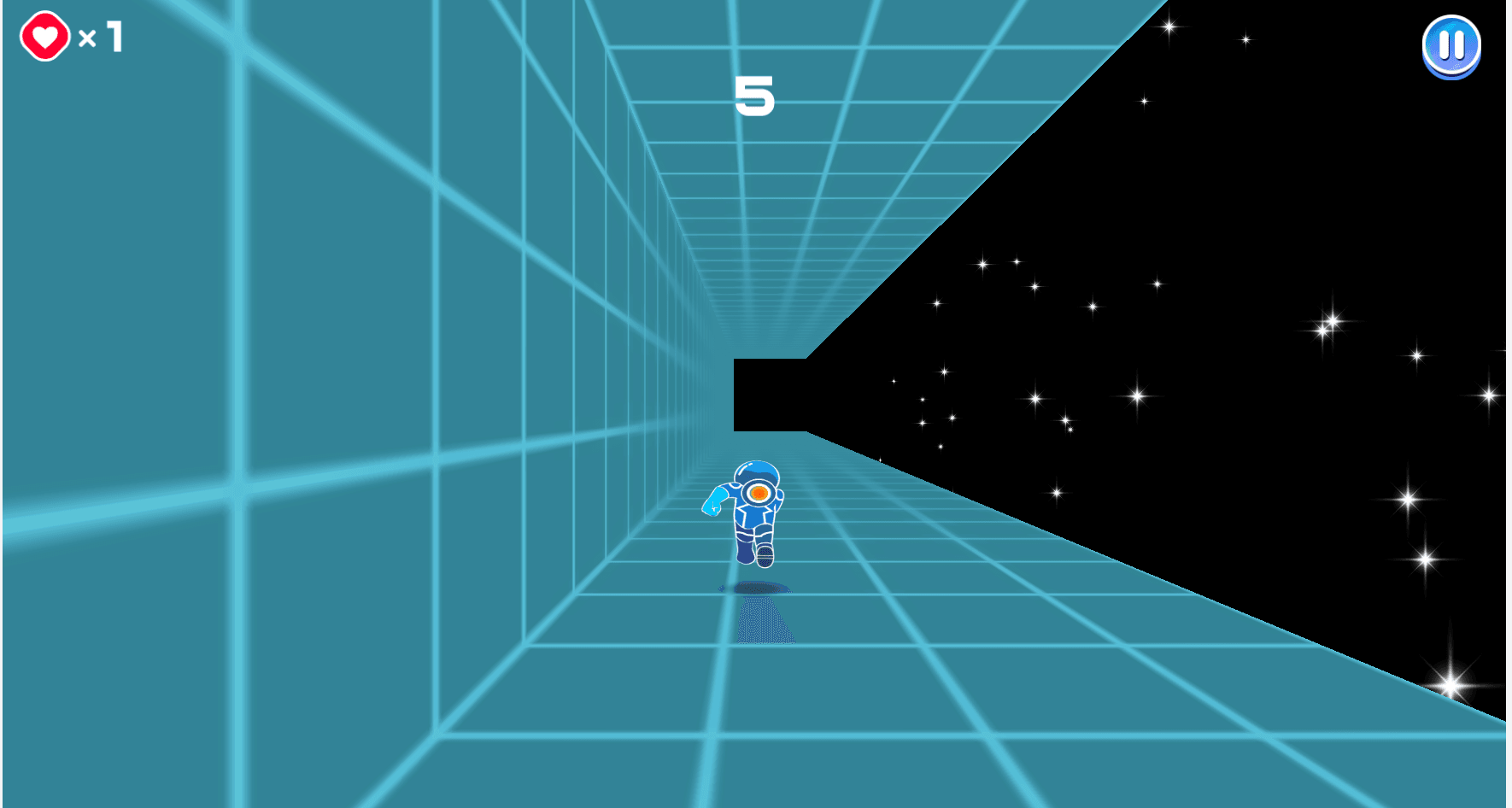
The tunnel is round, so both side walls are playable surfaces. When the floor breaks apart, moving sideways can carry you over the missing section. Walls have their own gaps and lasers, though, so treat them as another route rather than a safe zone.
Read the tunnel in layers
Do not stare at the obstacle closest to the runner. Instead, scan ahead in three passes: the floor first, then the left and right walls, then the hazards sitting between them. A surface can look open while a laser or a fall-away tile makes it a bad choice by the time you arrive.
If the floor disappears, decide whether the gap is short enough to jump or wide enough to send you to a wall. If a laser crosses your line, look for the surface it leaves open before you move. The earlier that decision happens, the less precise your timing needs to be.
Your first run, step by step
- 1
Start in the middle of the floor and let the first few obstacles come to you. There is no bonus for an aggressive opening.
- 2
Make your first lane change before the obstacle looks urgent. Early movement leaves room to correct.
- 3
Jump only when the gap is close and the landing surface is visible. One committed jump beats three nervous ones.
- 4
Check the walls whenever the floor looks broken. A sideways route is often safer than a long jump.
- 5
Take a heart only if the path to it is already clear. A life gained and immediately lost does not help the run.
Common beginner mistakes
- Holding a direction. A long press carries you past the lane you wanted. Tap, release, then adjust.
- Jumping out of panic. A jump is only useful when it ends on a surface you can see.
- Ignoring the walls. New players often stay on the floor and jump everything, even when a wall route is wider and safer.
- Trusting pale blue tiles. They are temporary. Land, keep moving, and do not plan a second landing on the same tile.
- Chasing every heart. Extra lives matter, but not when reaching one means crossing a laser or a wide gap.
A three-run practice drill
Instead of playing the same way and hoping for a better score, give each run one job. Run one: change lanes earlier than usual. Run two: jump only when you can name the landing surface before takeoff. Run three: collect one heart, then deliberately skip the next one. After each run, name the single decision that ended it. That is the habit to fix next.
Once these basics feel automatic, the Electron Dash tips guide covers wall routing, fall-away tiles, and riskier heart pickups.
Ready to test the basics?
Start a run and focus on one decision at a time.